Watches
Inside the case: what you are actually paying for
A mechanical movement is a spring released at a controlled rate. Six specifications separate a fine one from an ordinary one, and only two are advertised.
4 min read · 12 September 2026
Movements, proportion and the cost of ownership
What is actually inside a case, how a diameter behaves on a given wrist, and the servicing arithmetic that nobody puts on the price tag.
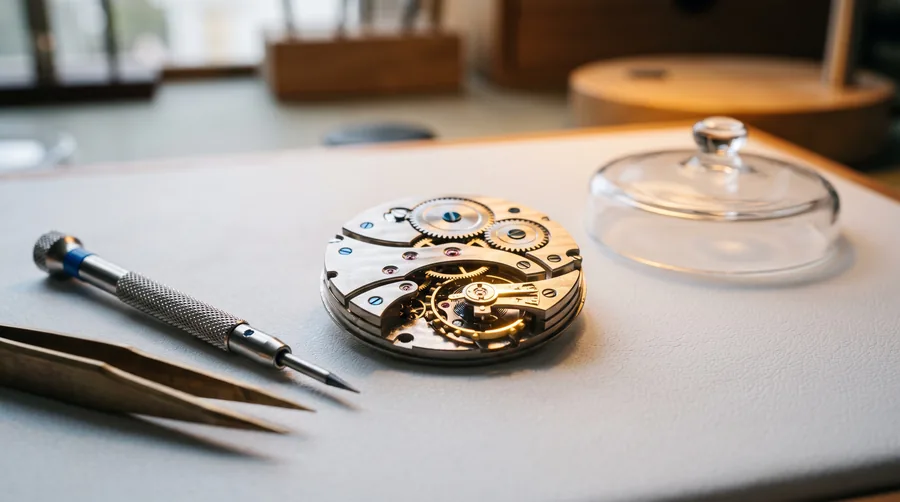
A mechanical movement is a spring releasing its energy at a controlled rate. Everything else is refinement: the beat rate that decides how the second hand sweeps, the power reserve that decides how long it survives in a drawer, the finishing that decides how it looks through the back, and the chronometer certification that decides how much of the accuracy claim is measured rather than asserted. A watch running at plus six seconds a day is a good watch. One running at plus twenty five is not broken, it is unregulated.
Proportion is the part people get wrong with money. A case diameter means very little on its own: lug to lug length is what decides whether the watch sits on your wrist or overhangs it, and thickness decides whether it goes under a cuff. A 40 mm case with 50 mm between the lugs wears larger than a 42 with 46. Measure the flat of your wrist, then buy to that number.
Then there is the running cost, which the trade prefers to discuss after the sale. A full service on a mainstream automatic runs from about 600 to 900 and is wanted every five to seven years. On a chronograph or a house movement it is 900 to 1,800, sometimes more, and the interval is the same. Over twenty years that is three services. It belongs in the purchase decision.
6 pieces
Watches
A mechanical movement is a spring released at a controlled rate. Six specifications separate a fine one from an ordinary one, and only two are advertised.
4 min read · 12 September 2026
Watches
Case diameter is the number on the page and it is close to useless. Two others decide whether a watch sits properly on your wrist.
3 min read · 11 September 2026
Watches
A mechanical watch has a running cost. Across twenty years it is often a quarter of the purchase price, and it is entirely predictable.
3 min read · 10 September 2026
Watches
A certification measures a movement in a laboratory before it is cased. What happens on your wrist is a different question with a different answer.
3 min read · 9 September 2026
Watches
The rating on a caseback is a static pressure test, not a depth. Here is what each figure actually permits.
3 min read · 8 September 2026
Watches
Most collections are an attempt to avoid a decision. The decision, taken seriously, has a fairly narrow answer.
2 min read · 7 September 2026
The desk asks
Instruments
The Atelier
Quartz is more accurate, cheaper to own and needs a battery every two to five years. Mechanical is an object with a service bill. Neither answer is wrong, but only one of them is an heirloom, and only one of them keeps correct time without being set.
For a calendar watch you wear rarely, yes, because it saves you resetting. For everything else it adds wear to a movement that would otherwise be resting. A watch does not deteriorate from standing still.
Measure your wrist across the flat. Under 16 cm, look for lug to lug under 46 mm. From 16 to 18 cm, 46 to 50 mm. Above 18 cm you have the freedom the rest of us do not. The case visualiser on this site draws it to scale.
It is a way to lose the pleasure of the thing and most of the money. A handful of references hold value, the majority lose thirty to fifty per cent the moment the box leaves the shop, and the ones that appreciate are usually unavailable at retail anyway.
The Friday file
A short letter on Fridays: a single material examined, the arithmetic behind a purchase people get wrong, and the one line from the week worth keeping. No offers, because there is nothing to sell.