Inside the case: what you are actually paying for
A mechanical movement is a spring released at a controlled rate. Six specifications separate a fine one from an ordinary one, and only two are advertised.
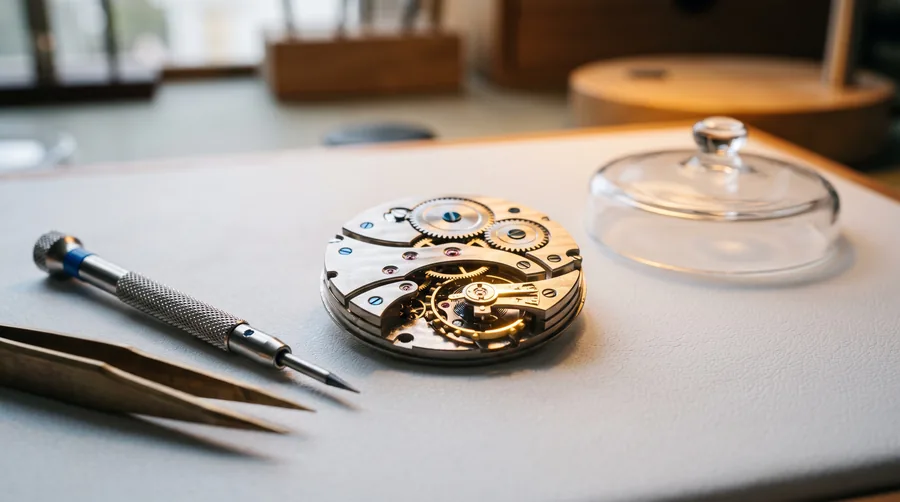
At a glance
- Beat rate
- 28,800 vibrations an hour is the modern standard
- Power reserve
- 38 hours is old, 70 hours is a weekend off the wrist
- Jewels
- Synthetic rubies as bearings, 17 to 31 is normal
- What finishing is
- Hand work on parts nobody sees, and it is the real cost
Strip away the case, the dial and the name, and every mechanical watch is the same idea: energy stored in a coiled spring, released through a train of gears, metered by an oscillating balance so that it comes out at a constant rate. It is a seventeenth century solution executed to twenty first century tolerances, and it is the reason a watch can cost a hundred or a hundred thousand.
The parts, in the order energy passes through them
- The mainspring, coiled in a barrel. Wound by hand or by a rotor that spins as the wrist moves.
- The gear train, which steps the energy down and drives the hands.
- The escapement, which releases the train one step at a time. This is the ticking.
- The balance wheel and hairspring, which oscillate at a fixed frequency and decide how accurate the whole thing is.
- The jewels, synthetic rubies set as low friction bearings at the points of highest wear.
Beat rate, which you can hear
Frequency is quoted in vibrations per hour. 18,000 is the old standard and gives a visibly stepped second hand, five ticks a second. 21,600 is common in vintage and in some modern movements chosen for long service life. 28,800, eight beats a second, is the modern default and gives the smooth sweep people associate with a mechanical watch. 36,000 is a high beat, more accurate in theory, and it wears its lubricants out faster.
Higher is not simply better. A faster balance is less disturbed by movement of the wrist, which helps accuracy, and it also completes more cycles per year, which means more wear and shorter service intervals. The choice is an engineering trade, not a quality ladder.
Power reserve, which decides how the watch fits your week
The old industry standard was around 38 to 42 hours, which is just enough to survive a night off the wrist and not enough to survive a weekend. Take such a watch off on Friday evening and it is stopped by Sunday morning. The move to 70 and 80 hour reserves across the last decade is the single most practically useful change in modern watchmaking, and it is achieved with a longer mainspring barrel, sometimes two, and a more efficient escapement.
Seventy hours is not a specification, it is the difference between a watch you wear and one you keep resetting.
Finishing, which is where the money goes
Two movements can have identical specifications and a tenfold price difference, and almost all of it is finishing: the decoration and refinement of components, much of it invisible once assembled. Anglage, the hand bevelling of the edges of bridges to a mirror polish, is the clearest tell and takes hours per movement. Perlage and Geneva stripes are surface patterns. Black polishing on steel components is a specific technique producing a surface that reads pure black at one angle and mirror at another.
None of it makes the watch keep better time. It is craft applied to a machine, which is either the whole point or entirely absurd depending on your temperament. What is worth knowing is how to tell hand work from machine work: look through the caseback at an inside angle on a bridge. A sharp interior corner can only be made by hand. A rounded one came off a machine.
In house, and why the phrase means less than it suggests
A movement made by the brand that sells the watch is described as in house, and the phrase carries a premium. It is worth separating two things: manufacturing capability, which is genuinely difficult and expensive, and outcome, which for the buyer is accuracy, reliability and serviceability.
The workhorse movements supplied by the large specialists are, by any measure, extraordinarily good. They are accurate, robust, understood by every watchmaker in the world and cheap to service because parts are available. A house movement may be finer, and it may also mean a five week wait and a return to the manufacturer for anything beyond a battery, which in twenty years will matter.
What to look at through the caseback
Interior angles, as above. Whether screw heads are polished and their slots aligned. Whether the rotor is solid gold or tungsten weighted, which affects winding efficiency and feel. Whether the regulating system is a simple index or a free sprung balance, the latter being harder to make, more stable over time and a genuine mark of a serious movement.
And whether there is a caseback to look through at all. A solid back is not a sign of a cheap watch. Several of the finest movements ever made are hidden, and a solid back is better for water resistance.
Spotted an error? Tell the desk