Jewelry
Cut, colour, clarity, carat, in that order
The four C are taught in the order that matters and bought in the reverse. Getting the order right is worth about thirty per cent of the price.
4 min read · 12 September 2026
Stones, metals and what a certificate does not say
The four C in the order the eye reads them, why an alloy decides what a ring looks like in ten years, and what a grading report proves and does not prove.
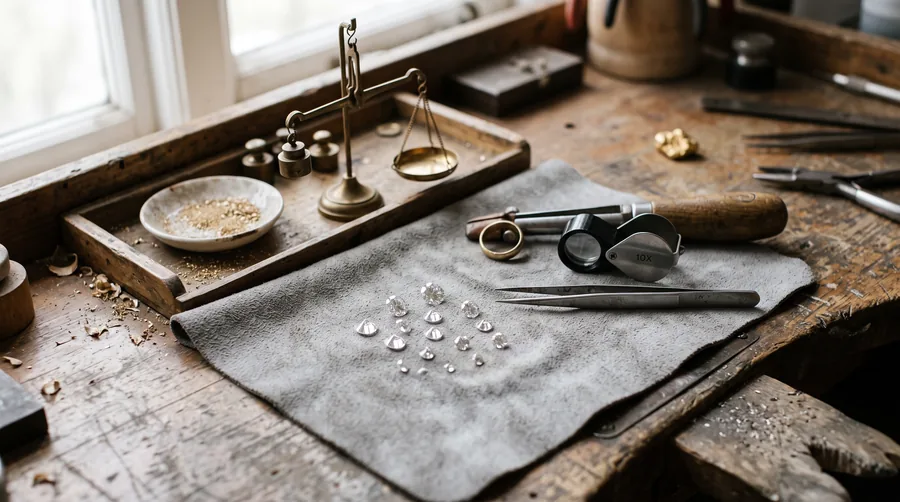
The grading of a diamond is taught in the order cut, colour, clarity, carat, and then almost everybody buys in the reverse order. That is the whole of the problem. Cut is the only one of the four that a human made, the only one that decides how the stone behaves in a room, and the only one that a photograph in good light will flatter into invisibility. Carat is the one the price list punishes hardest and the eye notices least, because weight goes up with the cube of the diameter while the face you see goes up with the square.
Metal is the half of the object nobody examines. Gold at 750 parts per thousand is 18 carat whatever colour it is, but the remaining 250 parts decide everything else: copper for the warmth of rose, silver and palladium for the paleness of white, nickel in older pieces for the hardness and the rash. White gold is rhodium plated and the plating wears through in eighteen months to three years on a ring worn daily. Platinum does not plate, does not fade and does not fail, and it is heavier, softer on the surface and more expensive to work.
A grading report is a description, not a valuation and not a guarantee of beauty. It tells you the measurements, proportions and identified inclusions of one stone on one day in one laboratory. Two stones with identical reports can sit quite differently in a setting, and the report will not tell you which one you will still like in five years.
6 pieces
Jewelry
The four C are taught in the order that matters and bought in the reverse. Getting the order right is worth about thirty per cent of the price.
4 min read · 12 September 2026
Jewelry
Every 18 carat piece is three quarters gold. The last quarter sets the colour, the hardness, the tarnish and whether your skin reacts.
3 min read · 11 September 2026
Jewelry
They are the same material. The differences are origin, price trajectory and what happens if you ever want to sell.
4 min read · 10 September 2026
Jewelry
Lustre is what you buy and nacre thickness is what decides whether you still have it in twenty years. One of them is visible in the shop.
2 min read · 9 September 2026
Jewelry
More stones are lost to a worn prong than to theft. How each setting fails, and how long you have before it does.
2 min read · 8 September 2026
Jewelry
A valuation is an instruction to an insurer, not a statement of what anybody will pay you. The difference has cost people a great deal.
2 min read · 7 September 2026
The desk asks
Instruments
The Atelier
Chemically and optically yes, it is carbon in the same lattice and it tests as diamond. What differs is origin, scarcity and resale. Lab stones have fallen steeply in price and continue to, so buy one for the object and not as a store of value.
Weight rises faster than the face you see. A stone of 0.90 carat is roughly 6.2 mm across, one of 1.00 carat about 6.4 mm. That is a third of a millimetre for a step in price that is often fifteen to twenty per cent.
Above roughly two per cent of your contents sum, yes, and household policies usually cap single items well below what a serious ring is worth. Specified item cover with a current valuation is the honest answer, and valuations go stale in three to five years.
Chlorine on alloyed gold, knocks on the girdle of a stone, and hand cream in the setting where it dulls the pavilion. Ultrasonic cleaners are fine for diamond in good settings and wrong for emerald, opal and most treated stones.
The Friday file
A short letter on Fridays: a single material examined, the arithmetic behind a purchase people get wrong, and the one line from the week worth keeping. No offers, because there is nothing to sell.