Why a beautiful room can feel wrong
A room that photographs perfectly and feels uncomfortable is almost always failing on one of two axes, and neither is visual.
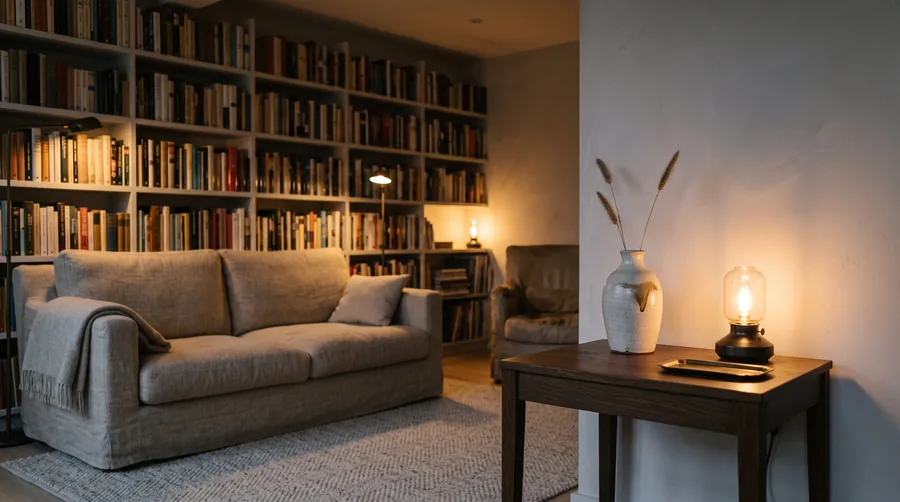
At a glance
- First axis
- Reverberation, which is hard surfaces with nothing to absorb them
- Second axis
- Shelter, meaning a back and an edge to sit against
- The measurement
- Clap once and count how long the sound hangs
- The fix
- Textile, and it works in any quantity
There is a kind of room, common in renovated flats and in every photograph of one, that is undeniably beautiful and that nobody sits in. Plaster walls, a concrete or hard timber floor, large windows, a few carefully chosen pieces. It looks superb and it feels like a waiting room, and the reasons are physical rather than aesthetic.
The sound problem
Hard parallel surfaces reflect sound. With nothing soft to absorb it, speech reverberates, consonants smear into one another and the brain works harder to follow a conversation. Nobody identifies this consciously. What they report is that the room is tiring, or that they end up in the kitchen.
The test takes a second. Stand in the middle and clap once. If the sound stops immediately, the room is fine. If it hangs, rings or slaps back, the room is over-reflective, and no amount of furniture arrangement will change it.
- A large rug with a felt underlay is the single most effective fix, and the underlay does as much work as the rug.
- Full length curtains in a heavy cloth, hung wider than the window and floor length even if the window is not, absorb across the frequencies that matter for speech.
- Books on open shelves are an excellent diffuser, which is part of why a room with books feels calm.
- Upholstered rather than hard furniture at the point where people actually sit.
Clap once in the middle of the room. If the sound hangs, the room is not finished, whatever it looks like.
The shelter problem
The second axis is older than architecture. People are more comfortable with something solid behind them and an edge to one side, and less comfortable in the open middle of a space with their back to a door. This is why the corner table in a restaurant goes first, why nobody chooses the middle seat of an empty row, and why a sofa floating in the centre of a large room is used less than one with its back to a wall or a shelf.
It also explains why an enormous open plan space frequently has to be broken up before anybody will settle in it. The tools are a rug to define a zone, a piece of furniture with height behind a seating group, and a light source at the edge of it. The effect is immediate and it is much larger than the effort suggests.
Temperature and the third axis nobody mentions
A room that is cool in colour, cool in light temperature and hard in surface reads as cold even when the thermostat says otherwise, and people compensate by turning the heating up two degrees for a year. Warm light, textile and one piece of timber or a warm toned material change the perceived temperature of a room by a surprising margin.
The reverse is also true and useful in hot climates, where a pale, hard, cool room is genuinely more comfortable, which is why the aesthetic reads as correct in the Mediterranean and faintly punishing in northern Europe.
What to do first
Clap. If it hangs, buy a rug with a proper underlay and hang curtains, in that order. Then move one seat so that it has a back to something and a lamp beside it. Both interventions together cost less than a chair and will change how much time people spend in the room, which is the only real measure of whether a room works.
Spotted an error? Tell the desk