Ten days, one bag, fourteen pieces
Packing is a combinatorial problem people solve emotionally. Solved properly, trip length stops determining case size.
At a glance
- The count
- Fourteen pieces and three pairs of shoes
- The rule
- Every top works with every bottom
- Cabin dimensions
- Commonly 55 by 40 by 20 cm and 8 kg
- The one worn
- The heaviest item goes on the flight, not in the case
The length of a trip stops determining the size of a case somewhere around day five. After that, you are packing for weather and occasion rather than for days, and a ten day trip needs almost exactly what a six day trip needs. Almost nobody packs this way, because packing is done the night before by a person imagining situations rather than counting combinations.
The fourteen
- Five tops. Two that layer under everything, two that stand alone, one for the good dinner.
- Three bottoms. One that walks, one that is smart, one that is the wildcard for the specific trip.
- Three layers. One light, one warm, one for weather. In summer the third is a rain shell and weighs nothing.
- Three extras from: a dress, a swimsuit, something for the gym, depending on the trip.
- Three pairs of shoes: the walking pair worn on the flight, one smart, one for the specific activity or the beach.
That is ten days covered with a wash halfway through, which every hotel and every apartment permits. The wash is the part people resist and it is what makes the arithmetic work: two days of laundry capacity converts a fourteen piece case into an unlimited trip length.
The colour spine, which does the actual work
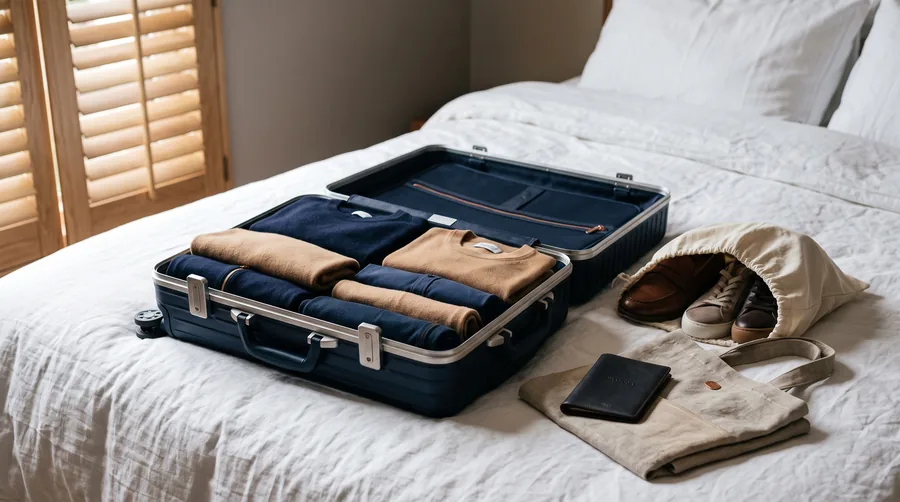
Every bottom and every layer comes from two neutrals that work together. Navy and camel, charcoal and cream, black and grey, olive and stone. Tops may include one accent colour. This single constraint is what produces the every top with every bottom property, and without it fourteen pieces produce maybe twelve outfits rather than forty.
The test before the case closes: lay it out and pair every top with every bottom out loud. Any pair that produces a wince is a piece that has to change, not an outfit to avoid, because the piece will take its combinations with it.
One item that only works with one other item is not one item. It is two, and it takes the space of two.
Shoes, which are the actual weight
Three pairs, and the heaviest is worn on the flight. Shoes are dense, awkward and the single largest volume decision in a case. The discipline is to choose by surface rather than by outfit: what will you walk on, for how long, and is there a wet day in the forecast.
Pack them sole to sole in a bag, at the hinge end of the case where the frame is stiffest, and fill them with socks, chargers and anything else small and crushable. A pair of shoes packed empty is a pair of shoes wasting its own volume.
The things that actually get forgotten
- A second pair of the socks you will walk in. Blisters end trips.
- Any medication, in its original packaging, in the bag that stays with you.
- A charger for each device rather than one shared, because the shared one is always in the other room.
- A folded tote, which weighs nothing and solves the market, the beach and the return journey overpacking problem.
- One cotton shirt more than you think, in a hot climate, because that is the item that becomes unwearable fastest.
Cabin only, honestly
Fourteen pieces and three pairs of shoes fits a 55 by 40 by 20 case with room to spare, in every season except deep winter, where the coat and the boots break the model and should simply be worn. The constraint that bites first is not volume, it is the eight kilogram weight limit that several airlines enforce and several ignore.
Weigh the packed case at home. The difference between eight and eleven kilos is usually two pairs of shoes and a book, and it is the difference between walking past a desk and paying at one.
Spotted an error? Tell the desk