Reading a fragrance by its architecture
Perfume is built in three stages that evaporate at different speeds. Once you can name the stages, the counter stops being a guessing game.
At a glance
- Top notes
- Ten to thirty minutes, mostly citrus and aromatics
- Heart
- Two to four hours, florals and spice
- Base
- Six hours and beyond, woods, resins, musks
- Concentration
- Eau de parfum 15 to 20 per cent, eau de toilette 8 to 12
The reason a scent smells wonderful on the card and wrong on the wrist two hours later is that you were comparing two different products. A perfume is a structure that reveals itself over hours, and the part that sells it at the counter is the part that will be gone before you reach the car park.
The three stages
Top notes are the most volatile molecules and they are gone in ten to thirty minutes. Citrus, light aromatics, anything green and sharp. They exist to make a first impression and they are almost never why anyone keeps wearing a fragrance.
The heart runs from about twenty minutes to four hours and is where the character lives. Florals, spices, fruit, the tea and iris accords that decide whether a scent reads as formal or soft. This is the part you should be judging, and it requires waiting.
The base is what remains after four hours and what other people mostly smell on you across a day. Woods, resins, vanilla, musks, leather and amber accords. It is also the part that interacts most with individual skin chemistry, which is why the same base can read warm on one person and almost soapy on another.
The families, briefly and usefully
- Citrus and aromatic: bright, short lived, excellent in heat, needs reapplication. Bergamot, neroli, petitgrain, lavender, rosemary.
- Floral: the largest family and the most varied. Rose and jasmine anchor the classics, iris reads powdery and expensive, tuberose and ylang read heavy and warm.
- Chypre: citrus over a mossy, woody base. Structured, formal, faintly bitter, the architecture of a great many classic perfumes.
- Fougere: lavender, coumarin and oakmoss. The backbone of most masculine fragrance for a century.
- Oriental or amber: resins, vanilla, spice and balsams. Warm, heavy, best in cold weather and at night.
- Woody: sandalwood, cedar, vetiver, oud. Dry rather than sweet, long lasting, the family that reads most quietly.
- Gourmand: edible notes, vanilla, caramel, almond, tonka. Divisive, very persistent, rarely appropriate in a meeting.
Concentration, and what it does not mean
Eau de cologne is 2 to 5 per cent aromatic compound, eau de toilette 8 to 12, eau de parfum 15 to 20, and parfum or extrait 20 to 30. A higher concentration is not simply a stronger version of the same thing: houses frequently reformulate between concentrations, adding base weight to an extrait and brightness to a toilette, so the eau de toilette and the eau de parfum of the same name can be genuinely different fragrances. Try both.
Testing properly
- Two on skin, maximum, per visit. The nose adapts within minutes and everything after the third becomes noise.
- On the wrist, not the card, and do not rub. Rubbing crushes the top notes and skips part of the structure.
- Leave the shop and wait four hours. If the base is not something you want to live with, the top notes are irrelevant.
- Test in the season you will wear it. Heat accelerates evaporation, so a scent that is elegant in October can be overwhelming in July.
Buy the base. The top notes are an advertisement for a product you stop wearing after twenty minutes.
Storage, which decides how long a bottle lives
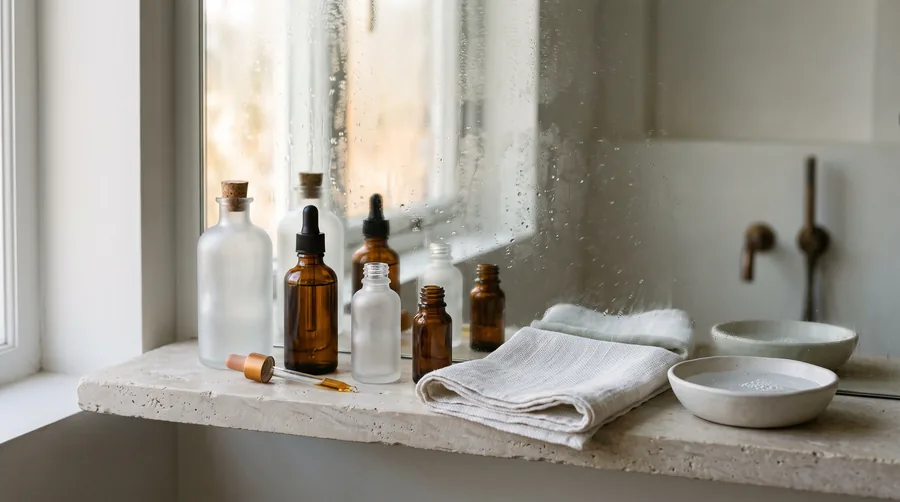
Light, heat and oxygen are the three enemies and a bathroom shelf offers all three. Kept in a box, in a cool cupboard, an eau de parfum lasts four to five years. On a windowsill it can turn in eighteen months, and a citrus dominant one faster than that. A bottle that has darkened noticeably or gone sharp at the opening has oxidised, and no amount of wishful spraying will bring it back.
Bottles also stop working when they are nearly empty, because the ratio of air to liquid rises and oxidation accelerates. The last quarter of a bottle is often noticeably worse than the first, which is an argument for smaller bottles and more of them.
Spotted an error? Tell the desk